

How Generative Engine Optimization Works: Decoding AI Search Ranking Factors
As conversational assistants and AI-driven answer engines redefine how people discover information online, the foundational mechanics of visibility have shifted. In our overarching overview of The Definitive Master Guide to Generative Engine Optimization (GEO) for Businesses, we established why adapting to artificial intelligence is essential for modern brand authority. However, transitioning strategy into execution requires a deep dive into the underlying engine: how generative engine optimization works.
Unlike legacy search algorithms that calculate rankings through keyword density and backlink volume, modern LLM-driven platforms evaluate content through semantic proximity, vector spaces, and probabilistic retrieval. Understanding these specific AI search ranking factors allows businesses to structure their digital assets so that platforms like ChatGPT, Gemini, and Perplexity actively cite them as primary sources.
The Technical Mechanics: Retrieval-Augmented Generation (RAG) and Search
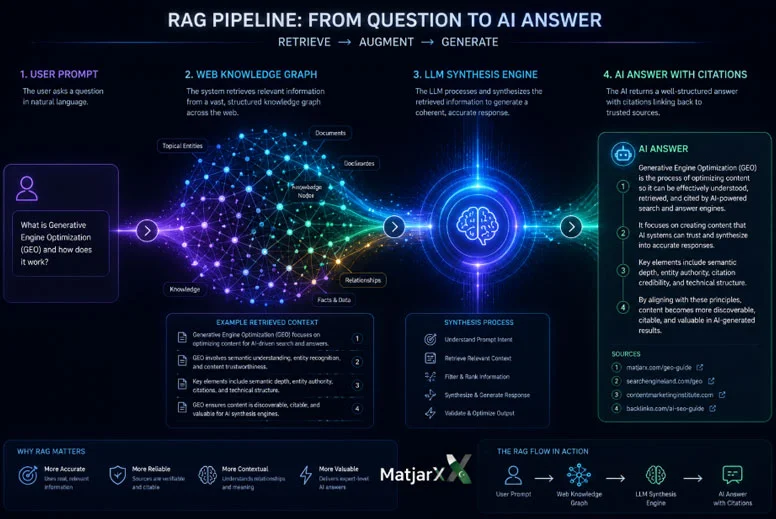
To optimize for generative engines, you must first understand how they process information. When a user enters a prompt, an AI search engine rarely relies solely on its static training data. Instead, it utilizes a framework known as Retrieval-Augmented Generation (RAG).
The RAG Pipeline Explained
- Query Parsing: The AI analyzes the user’s conversational prompt to extract underlying intent, constraints, and implicit questions.
- Real-Time Web Retrieval: The engine queries its index for web pages, documents, and structured data repositories that match the semantic context of the prompt.
- Re-ranking and Filtering: Retrieved snippets are evaluated for authority, sentiment, structural clarity, and factual density.
- Synthesis and Generation: The LLM synthesizes the extracted information into a coherent, single-answer response, embedding citations or source links where appropriate.
Because of this multi-step pipeline, optimizing your content requires a completely different technical approach than traditional search. Businesses can build a rock-solid foundation for this by ensuring their site architecture aligns with insights from our guide on Professional Website Builds Trust.
Decoding AI Search Ranking Factors vs. Traditional SEO
Contrasting Mechanics: GEO vs SEO
Optimization Vector | Traditional SEO Mechanics | GEO Mechanics & AI Ranking Factors |
Primary Target | Exact match keywords, meta tags, and title tags. | Semantic intent vectors, entity relationships, and contextual depth. |
Link Evaluation | Backlink volume, domain authority (DA), and anchor text diversity. | Contextual citations in synthesized text, off-site brand sentiment, and cross-platform mentions. |
Content Formatting | Paragraph length, heading tags for keyword placement, and image alt text. | Clean HTML semantic markup, JSON-LD structured data, data tables, and statistical density. |
Evaluation Speed | Periodic crawler indexing and slow ranking fluctuations. | Dynamic RAG retrieval, real-time context parsing, and probabilistic citation generation. |
When analyzing GEO vs SEO mechanics, it becomes clear that modern search engines reward content that reads naturally to humans while remaining structurally transparent for machine parsers. Ensuring your digital platform is optimized for seamless mobile parsing as outlined in our Mobile-First Design Tips for UX, directly improves how AI crawlers ingest your layout.
How AI Search Engines Cite Sources and Why It Matters
One of the most critical aspects of generative engine optimization is understanding how AI search engines cite sources. When an LLM generates a response, it doesn’t randomly pick URLs; it selects sources that exhibit high factual density, statistical credibility, and unambiguous entity ownership.
Key Drivers of AI Citations
- Empirical Data and Statistics: Research into generative optimization reveals that AI engines heavily favor content featuring verifiable data points, numerical tables, and explicit research findings.
- Expert Quotation Attribution: Content that incorporates named expert insights and direct quotes receives a higher preference score during the RAG synthesis phase.
- Unambiguous Brand Entities: If your business is clearly defined across knowledge graphs with consistent Name, Address, and Phone (NAP) data, Sadapay/JazzCash integrations, or product catalogs, the AI can attribute claims to your brand with confidence.
To support these technical optimizations, your hosting and domain infrastructure must be pristine. Reviewing Domain and Hosting Explained ensures your servers do not throttle AI web crawlers attempting to fetch your structured data.
Structuring Content for Machine Readability and Semantic Depth
Best Practices for Structural Optimization
- Deploy Advanced Schema Markup: Implement Organization, Product, FAQ, and Article JSON-LD schema so LLMs instantly understand your page elements without guessing.
- Build Comprehensive FAQ Modules: AI engines love direct question-and-answer pairs because they mirror conversational prompts. Structuring your content to directly answer sub-queries increases your chances of being pulled into a synthesized snippet.
- Eliminate Technical Friction: Slow load times and poorly optimized conversion funnels can hurt user engagement signals, which indirectly affect overall digital authority. Check out Top 5 Website Mistakes Killing Conversions to clean up layout errors.
Advanced Algorithmic Signals: Beyond Basic Keywords
In the first half of this guide, we explored the Retrieval-Augmented Generation (RAG) pipeline and how AI models parse semantic intent. To truly master how generative engine optimization works, we must look deeper into the secondary algorithmic signals that influence whether an AI platform elevates your brand or bypasses it entirely.
Semantic Density and Contextual Richness
To ensure your brand builds broad topical authority that AI models trust, align your foundational strategy with our comprehensive resource on The MatjarX Complete Guide for Small Businesses.
Real-World Authority: Translating Brand Trust into AI Citations
Cultivating Off-Site Signals for GEO
- Cross-Platform Brand Mentions: Consistent references on industry forums, news outlets, and business directories reinforce your entity profile in AI knowledge graphs.
- Transparent Case Studies and Proven Results: Sharing real operational insights; similar to the practical lessons found in our Rastah Case Study Lessons for Small Businesses gives AI models concrete business examples to reference when answering user queries about industry success.
- Streamlined Digital Touchpoints: Ensuring your customers have a seamless experience from discovery to conversion builds positive sentiment that naturally reflects in online reviews and social chatter, which AI crawlers monitor.
Technical Integration: Optimizing Your Infrastructure for AI Crawlers
Key Technical Priorities
- Clean Code and Semantic HTML: Use proper heading structures (H1, H2, H3), clean tags, and descriptive anchor text so LLM scrapers can easily segment your content.
- Lightning-Fast Page Speeds: AI crawlers operate at scale; slow server response times can cause timeouts, leaving your latest updates unindexed.
- Local and Regional Readiness: For businesses targeting specific geographic markets, integrating seamless local setups such as configuring regional payment solutions like Setup SadaPay SadaBiz on Your Website, Setup JazzCash Jazz Business on Your Website, Setup Easypaisa Business on Your Website, or Setup PayFast Payment Gateway, creates clear transactional entities that AI engines recognize when processing regional buyer intent.
Furthermore, exploring broader market directions via Digital Marketing Trends in Pakistan 2026 helps you stay aligned with how regional digital infrastructure is evolving to meet AI search demands.
Measuring Success: Tracking AI Visibility and Citations
Essential GEO Metrics
- Share of Model Voice: Tracking the percentage of time your brand or product is recommended by AI search engines compared to direct competitors for high-intent prompts.
- Referral Traffic Quality: Analyzing session duration and conversion rates from AI-driven referral links (such as citations in Perplexity or Microsoft Copilot).
- Brand Sentiment in AI Summaries: Monitoring the qualitative tone of how AI models describe your business when generating answers.
To amplify these digital marketing efforts and turn organic AI visibility into concrete sales, leverage professional frameworks like our Growth Marketing Service or explore streamlined setup solutions via our Done-For-You Website package.
Conclusion: Mastering AI Ranking Factors for Long-Term Growth
Decoding AI search ranking factors and mastering GEO vs SEO mechanics gives your business a definitive competitive advantage. As conversational search continues to displace traditional blue links, aligning your content architecture, technical infrastructure, and entity authority with how LLMs process information ensures your brand remains front and center.
Whether you are scaling your digital footprint or refining your conversion pathways, start building your AI-ready strategy today by reviewing our core insights in Why a Website Is Important for Business.
Related Posts
- Mastering AI Search: Best Generative AI and GEO Training Courses for Marketers
- Hiring a GEO Expert: Top Generative Engine Optimization Agencies and Consulting Services
- Top GEO and Content Automation Tools to Scale Your Search Strategy in Pakistan
- Beyond Blue Links: How Generative Engine Optimization Drives Traffic and Best Practices for AI Citations
- How Generative Engine Optimization Works: Decoding AI Search Ranking Factors


